
Pick the Option Your Remaining Teeth Can Carry
If you’re weighing a partial denture vs bridge in Tewksbury, you’ve likely lost a tooth or two. The common worry is paying for a fix and then losing the healthy teeth holding it in place. Pick the wrong design, and those anchor teeth can be the next ones to go.
Dr. Elaine Wu, DMD received the Department of General Dentistry Excellence in Implantology Award, Boston University. She also completed a rigorous 260-hour advanced training program at the Kois Center in Seattle, WA, becoming a full graduate. Her training puts the diagnosis first, so you’ll know what your teeth can handle before anyone hands you a quote. Bridges and partials both sit among the denture and tooth replacement options in Tewksbury she plans.
Is It Better to Have a Bridge or a Partial Denture for One or Two Missing Teeth?
With one to three teeth missing in a row and healthy teeth on both sides, a bridge is usually the stronger fit. A partial handles scattered gaps better, even when no sound tooth stands behind the space. A full denture only comes into the picture once every tooth in the arch is gone.
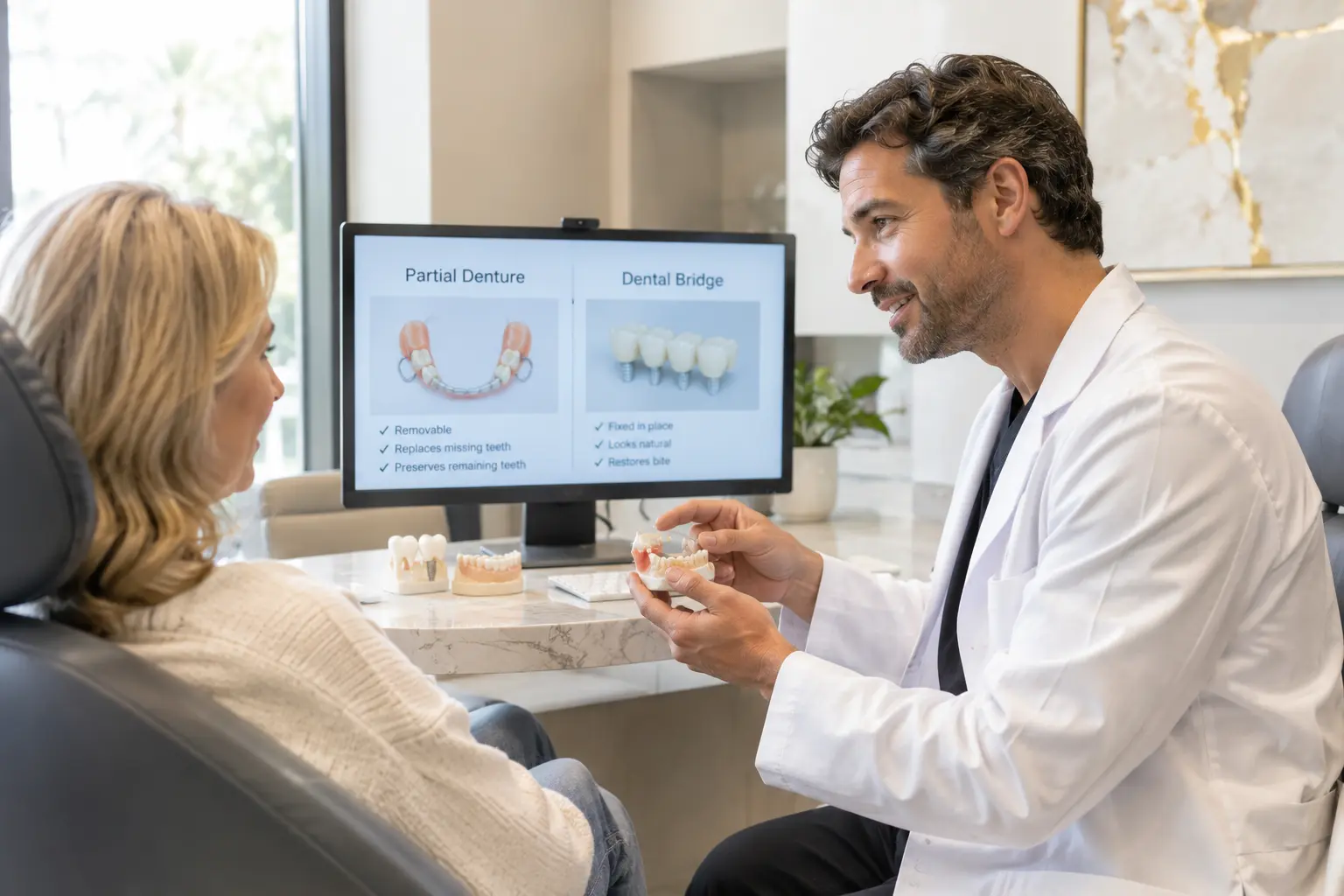
A bridge is cemented in, so you clean around it and mostly forget it’s there. A partial clips on with small metal clasps, and you take it out every night. The dentures and partials we make here come in resin or cast metal, and your bite decides which one fits.
How Does a Bridge Stay In Compared With a Partial Denture?
A traditional bridge is cemented onto crowns over the two teeth beside the gap, so it stays put for years. A partial holds on in a different way. Small clasps hug your teeth, little rests sit on top of them, and you lift the whole thing out by hand.
To build a bridge, both neighbor teeth get shaped down for crowns, and lost enamel doesn’t grow back. If those teeth already have big fillings, though, a crown can protect them. The dental crowns on a bridge are the same ones used to rebuild a single broken tooth.
A partial leaves your enamel mostly alone, which is its biggest advantage. The trade-off is daily handling, since it comes out for cleaning and sits in water overnight. A clasp may also show near the front.
Which Lasts Longer, a Bridge or a Partial Denture?
Bridges last longer in the research, by a wide margin. In a 2004 systematic review, 89.1% of conventional bridges were still in place after 10 years. A 2024 study of 842 metal-framework partials found 49.5% still in service over the same stretch.
The partial number needs some context, because the two studies followed different patients. In 95.6% of the partial failures, an anchor tooth gave out while the partial itself held up fine. Either way, results vary, and the health of your remaining teeth decides how long each option lasts.
Source: Tan and Pjetursson, Clinical Oral Implants Research, 2004. Quintessence International, 2024.
Does a Bridge or a Partial Ask More of Your Healthy Teeth?
Both lean on your natural teeth, but in different ways. A bridge trims two teeth once and then carries your bite through their roots for years. A partial barely touches your enamel, yet its clasps tug sideways every time you put it in or take it out.
- A bridge permanently reshapes both neighbor teeth for crowns
- Decay can start along a crown edge, right under the false tooth
- Clasps hold plaque against your teeth for most of the day
- In the 2024 study, some clasp designs went with more lost anchor teeth
- With either one, a weak anchor tooth puts the whole thing at risk
None of these risks makes either option a bad choice. They do mean your exam should check the anchor teeth first. A loose tooth won’t do well under either one.
How Do a Partial Denture and a Bridge Compare Side by Side?
Here are the five factors that matter most when you compare the two side by side. A bridge wins on lifespan, while a partial wins on insurance coverage and on saving enamel. Fees aren’t listed, because your cost depends on which teeth are involved.
| Factor | Partial denture | Bridge |
| How it stays in | Clasps and rests on your teeth | Cemented to crowned neighbor teeth |
| Healthy tooth reduction | Little or none | Two teeth crowned |
| In service at 10 years | 49.5% of 842 metal-framework partials | 89.1% in a systematic review |
| Most common failure | Losing an anchor tooth | Coming loose, then decay |
| MassHealth, age 21 and over | Can be covered when requested | Not covered in most cases |
Source: Tan and Pjetursson, 2004. Quintessence International, 2024. 130 CMR 420.429(A).
Read the table against your own mouth, not as a final ruling. A bridge only keeps its lifespan edge when both neighbor teeth are strong. Your own result depends on your teeth, and results vary.
When Is Neither One the Right Fit?
Sometimes the honest answer is neither one, and a good exam should say so plainly instead of pushing a treatment that won’t last. A careful first exam checks for these five warning signs. Any one of them can rule out both a bridge and a partial.
- Anchor teeth already loose from bone loss
- Gum disease that hasn’t been treated yet
- A gap of four or more teeth with weak support at either end
- A missing back tooth with nothing solid behind it
- Daily cleaning around clasps or under a bridge that won’t fit your routine
In those cases, a dental implant can replace the tooth without leaning on its neighbors at all. It takes longer, since implants need enough bone and a few months to heal. In return, the neighbor teeth stay untouched.
Does MassHealth Cover a Bridge or a Partial Denture for Adults?
For most adults, the answer is no. Under state rule 130 CMR 420.429(A), MassHealth covers bridges only on front teeth for members under 21. Adults can get a removable partial covered when the dentist requests it properly, but plans vary, so check yours.
In one Board of Hearings case, MassHealth denied an adult’s request for two back-teeth bridges. It offered to consider a partial instead. For most adults on MassHealth, though, the real choice is a covered partial or a bridge you pay for yourself.
Source: 130 CMR 420.429(A), MassHealth Board of Hearings appeals 2300223, 2305200 and 2176797, retrieved 9 October 2026.
Keep the Healthy Teeth You Still Have
Patients come in from South Tewksbury, Shawsheen Village and along Main Street, and we’re minutes from the Tewksbury Public Library. Dr. Elaine Wu holds a Doctor of Medicine in Dentistry, summa cum laude honors, Boston University School of Dental Medicine. She also plans implant care, so an implant stays on the table when a bridge or partial won’t work. Her Kois training shows up as looking first, deciding second, and naming the smaller treatment when it fits.
One visit tells you whether your anchor teeth can carry a bridge, a partial, or neither. Call 978-451-1500 or schedule an evaluation, and bring any partial or old bridge you wear now. You’ll leave knowing which option protects the teeth you’re keeping.
Questions Tewksbury Patients Ask About Bridges and Partials
Why would a dentist not recommend a bridge?
Usually the teeth on either side can’t carry the load. Cleveland Clinic notes that abutment teeth too weak to support a bridge can fracture. With active gum disease, a dentist treats the gums first, since a bridge on shaky support tends to fail early.
Why does a doctor prefer a bridge over an implant?
Usually it comes down to timing and bone. Mayo Clinic explains that an implant needs enough jawbone or a graft, and the process can take many months. A bridge usually takes two visits, and if the neighbor teeth need crowns anyway, it fixes them and fills the gap.
What type of dentures are the most comfortable to wear?
Fit matters more than the type. Implant-retained designs move the least, and a cast metal partial sits steadier than a resin one. The ADA says new dentures can feel awkward for a few weeks while your cheeks and tongue adjust. Speak up early about sore spots, because a quick adjustment usually fixes them.
Are dentures a bridge?
No, though they’re easy to mix up. A denture comes out, while a bridge is cemented in and only a dentist can remove it. The confusion comes from dentists calling a bridge a fixed partial denture. NIDCR survey data shows US adults aged 20 to 64 keep 25.5 of their 32 permanent teeth on average. So most people weighing these options still have teeth to build around.