
Keeping the Teeth You’ve Still Got
A partial denture replaces what you’ve lost by leaning on what you’ve kept. That second half rarely comes up before you say yes. Those anchor teeth end up carrying a load nobody designed them for. Most patients here never say that worry out loud. It’s fair, because the appliance can quietly cost you more teeth. This page tells you what moves the fee and what your coverage pays for. It also covers which of your teeth take the load.
Dr. Elaine Wu, DMD was inducted into Omicron Kappa Upsilon, the national dental honors society, for academic excellence and character. She then completed the Kois Center program, which isn’t a weekend course. It’s a multi-year curriculum built around one question. What is going on in this mouth, before anyone proposes fixing it? So the first appointment here is an assessment rather than a sales conversation. It happens before we pick from the denture options at ReNEW Dental. On a partial case, most of that assessment is about the teeth that are staying rather than the ones going. Get it right and you’ll keep eating normally for years. Get it wrong and you lose an anchor tooth, which takes the partial with it.
Which of My Teeth Will the Partial Attach To?
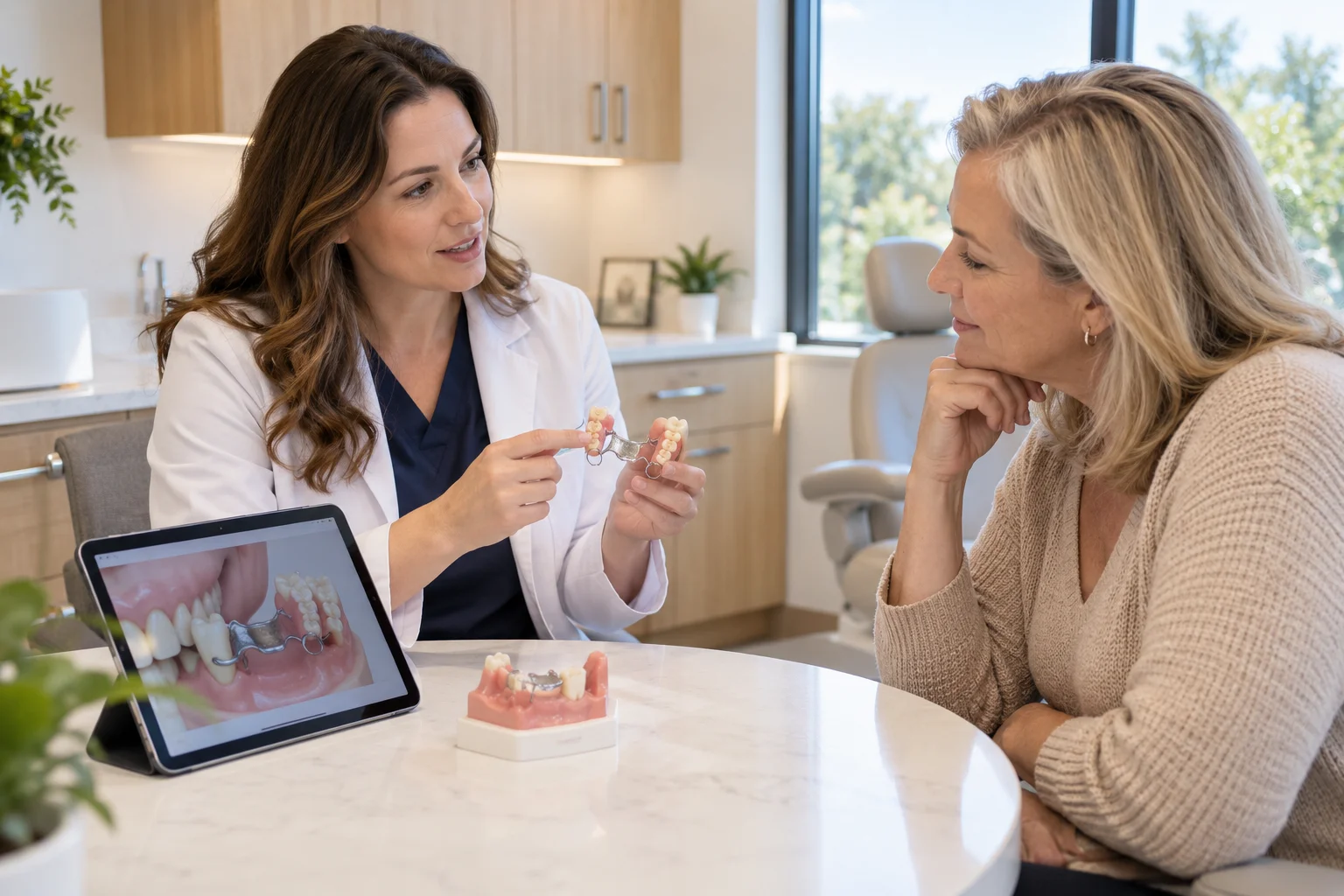
Your partial grips your own teeth using clasps and rests. Most designs lean on 2 to 4 of them, and dentists call these anchor teeth abutment teeth. The clasp holds the appliance down so it doesn’t lift while you eat. The rest sits on the biting surface and drives chewing force through the root.
Which teeth get picked comes down to where your gaps sit and how much bone still holds each candidate. A tooth with solid bone and a sound root makes a good abutment. One that already has a bit of give doesn’t. Load it anyway and the plan tends to fall apart inside a couple of years.
Do Partial Dentures Damage the Teeth They Clip Onto?
They can, and we’ve got numbers rather than opinions. Researchers followed 174 clasp-retained partial dentures through 25 years of university records. Abutment teeth decayed in 31.6 percent of patients. Gum inflammation around those same anchor teeth appeared in 35.6 percent of cases.
Source: retrospective study of 174 clasp-retained removable partial dentures, Regensburg University Medical Center, cases from 1984 to 2009, published 2012.
Nothing about the metal is eating your teeth. The trouble is what settles underneath. A clasp arm and framework give plaque somewhere to sit all day, in spots your toothbrush skims past. Saliva can’t wash across a covered tooth either.
None of which argues against a partial. Roughly 90 percent of those appliances were still going at ten years. The appliance outlasting the teeth underneath it is the pattern worth understanding. It’s your anchor teeth that need attention, and results vary between people.
Why Do Clasped Teeth Loosen or Decay Faster?
Two separate forces work on an abutment tooth, and they cause different trouble. One is mechanical. It shows up as looseness, while the other is biological and drives decay at the gumline. Reported abutment tooth loss runs as high as 38 percent over eight years.
Source: Shugars et al., reported in McCracken’s Removable Partial Prosthodontics, twelfth edition, 2011.
- Your teeth handle pressure straight down the root. A clasp pulls sideways every time the partial goes in.
- The rest transfers chewing force at an angle the tooth never evolved to take.
- Bone remodels in response, so a tooth loosens by degrees.
- Decay under a clasp arm starts on the root surface near the gum.
- Months can pass without any pain at all.
None of that is inevitable. Where the clasps sit and how they’re shaped changes how much of it reaches the tooth. That’s a design decision, and it gets made before anything goes to the lab.
What Does a Partial Denture Cost in Tewksbury?
Most partial dentures here fall between $1,400 and $2,100 for one arch. That covers the impressions, the framework, the teeth, the clasps and rests, and the fitting visits afterward. Where you land inside it comes down to the framework material and how many teeth you’re replacing. A resin partial sits at the lower end of that range. A cast metal framework sits at the upper end, and it’s the one that holds its fit longest.
Two things sit outside that figure and get quoted on their own. Extractions run $250 to $325 a tooth and have to heal before anything final is made, though impacted wisdom teeth are priced separately. Sedation runs $350 to $1,000 depending on what you need. There is no reline fee here, because a soft reline during active treatment is included in your treatment fee. Ask for all three numbers at the consultation, since a quote naming only the appliance is not a quote for the treatment. Fees vary by case and coverage terms vary by plan.

What Moves the Cost of a Partial Denture Up or Down?
Two things set your out-of-pocket figure. The second one surprises people. The framework material sets the lab bill, and coverage then decides how much of it you carry. MassHealth pays for a resin partial denture for adults, codes D5211 and D5212. It does not cover the cast metal version past age 21. Adult dental benefits also run against an annual cap of $1,750 a year.
Sources: MassHealth Dental Manual Subchapter 6, Service Codes, Prosthodontic (Removable) Services, listing D5213 and D5214 as covered under age 21 only. Confirmed against Board of Hearings decisions 2208111 and 2416131. Massachusetts dental rates are set in 101 CMR 314.00. Adult annual benefit cap per the Massachusetts Dental Society, effective 1 August 2026. Retrieved 9 September 2026.
| Retainer design | How it grips | Force on the tooth | What drives its cost |
| Cast circumferential clasp | Rigid arm wraps the crown | Firmer, more lateral pull | A milled metal framework |
| Wrought wire clasp | Thin round wire arm | Flexes, transmits less | Wire added to an acrylic base |
| RPI design | Small contact near the gumline | Disengages under load | Custom framework design time |
| Precision attachment | Interlocks inside a crown | Directed down the root | A crown built first, then the attachment |
Read that table against your own coverage. The cast metal framework holds its fit longest, and it’s the one MassHealth stops paying for at 21. So plenty of adults choose between the sturdier appliance and the covered one. Extractions and a later reline are priced separately again. Current figures by appliance type sit on our denture cost page, and payment terms under denture costs and financing.
How Often Should the Supporting Teeth Be Checked?
Once a year is standard advice for denture wearers. Abutment teeth need more, and twice a year is a sensible floor. The Regensburg records show why. Decay-free abutment teeth dropped from 58.4 percent at five years to 39.6 percent at ten.
We’re looking for slight movement that wasn’t there last visit, and for bone changes around a root. Radiographs pick up early decay at the gum margin, under the clasp where you’d never see it. A partial that’s stopped seating properly torques its anchors instead of resting on them. Catching that early costs far less than remaking the appliance.
When Is a Partial the Wrong Choice for My Teeth?
Sometimes the honest answer is your remaining teeth can’t carry a removable partial. Saying that costs a practice the case, and we say it anyway. Knowing when not to treat is a large part of what the Kois curriculum teaches. Loading a compromised tooth buys two years and then costs you the tooth. That doesn’t leave you without options. It means the load has to go somewhere other than your own teeth.
- Anchor candidates that already move from bone loss.
- Gum disease that hasn’t been treated and stabilized first.
- A gap at the back of the arch with nothing sound behind it.
- A tooth carrying old root treatment and a weakened root.
- Daily cleaning that isn’t realistic, whether from dexterity, eyesight, or routine.
Where any of that applies, an implant-retained design carries load through bone instead of your own teeth. Our page on dentures with implants sets out how.
Know Where Your Anchor Teeth Stand
Patients drive to us from North Tewksbury, Wamesit, and along the Route 133 corridor. Plenty arrive wearing a partial nobody’s checked in years. Most are surprised how much of the exam is about the teeth they still have rather than the ones missing. Dr. Elaine Wu earned her Doctor of Medicine in Dentistry summa cum laude at Boston University School of Dental Medicine. Her Kois training is why the exam comes before the estimate. The practice sits minutes from the Tewksbury Town Common.
One appointment tells you whether your partial is working with your anchor teeth or against them. Call 978-451-1500 or schedule an evaluation, and bring the partial you’re wearing now. Eating what you want without wondering which tooth goes next is a reasonable expectation.
Questions Tewksbury Patients Ask About Partial Dentures
Why can’t you sleep with partial dentures?
Your gums need time uncovered to stay healthy. Wearing an appliance around the clock denies them that. The American Dental Association advises removing dentures for at least four hours in every 24. Overnight works for most people. Sleeping in one also presses plaque against your abutment teeth all night, exactly where clasp decay starts.
Does gum disease go away once you replace missing teeth?
No. Replacing teeth doesn’t treat the infection that caused the loss. A partial placed over untreated disease tends to make it worse faster. The NIDCR describes periodontal treatment as a deep cleaning below the gumline, with surgery in advanced cases. So any partial plan starts by stabilizing your gums. Build onto teeth with active disease and you’ve anchored it to a foundation still breaking down.
What are the common failures of a fixed partial denture?
A fixed partial denture is the clinical term for a bridge, not the removable partial described here. Cleveland Clinic notes that a bridge most often spans one to three teeth. It crowns and relies on healthy natural teeth either side of the gap. Failures usually trace to decay under a crowned support tooth, or cement breaking down at a margin. A bridge also alters two healthy teeth permanently, where a clasp doesn’t.
What are the downsides of having partial dentures?
Beyond what happens to your anchor teeth, the downsides are daily ones. The appliance comes out for cleaning and needs storing properly. Mayo Clinic notes that most types must stay moist or they lose their shape. Bone underneath keeps changing after tooth loss, so the fit drifts and relines become part of ownership. None of that makes a partial a poor choice, but it is a choice with maintenance attached.
Related Services